
Story Retell Activities for Speech Therapy: The Complete Guide
By Karen Krogg, M.S., CCC-SLP
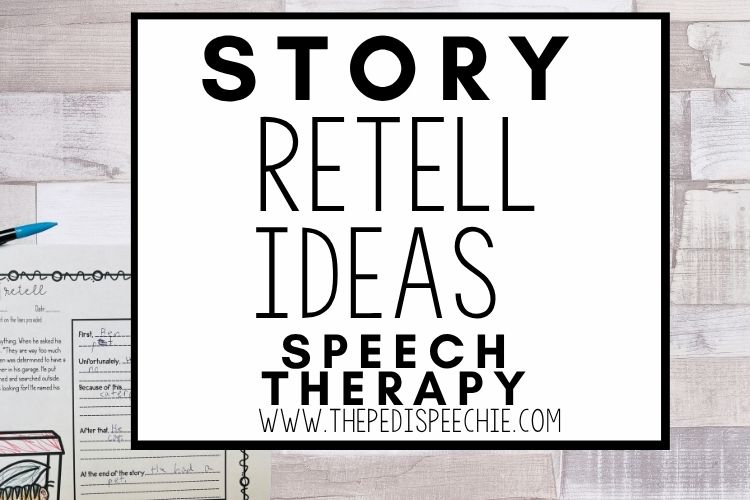
Story retelling is the ability to rephrase a story using your own words. To successfully retell a story, you need to include story elements such as the characters, setting, problem, events, and resolution. These story retell activities for speech therapy are designed to help SLPs target this area. SLPs often target story retelling in speech therapy sessions because it’s a great way to address multiple language and academic skills. It allows students to learn to organize information into a logical sequence, improves comprehension, increases expressive language skills, and supports literacy success.
I’m Karen Krogg, a CCC-SLP with 15+ years of experience in pediatric outpatient and schools. I’ve worked on this skill area several times, and I’d like to share some successful story retell activities and techniques to try in your own speech therapy room.
This post contains amazon affiliate links, which means we could receive a commission if you click a link and purchase something that we have recommended.
Why Do SLPs Work on Story Retelling?
Speech-language pathologists often work on story retelling skills in speech therapy. There are several reasons why.
First, story retell goals help strengthen narrative language skills. Retelling stories involves the ability to logically sequence events into a beginning, middle, and end, so the listener isn’t confused. Students learn to identify story grammar elements, including characters, setting, problem, events, and resolution.
Second, working on story retelling goals increases comprehension. To retell a story (and explain it!), students need to understand it! This means they’ll need a grasp on key details, main ideas sequence, and cause-and-effect.
Finally, working on story retell is a great way to increase expressive language skills! Students can practice creating complex sentences using transition words (such as ‘first, next’), conjunctions, and a variety of vocabulary. Learn more about how I teach sentence structures in speech therapy.
CUBED-3 Free Assessment for Narrative Language
I can’t write an article about treating this area without mentioning CUBED-3.
CUBED-3 is a free literacy assessment that measures language, decoding, and reading comprehension.
The CUBED-3 is a wonderful tool for screening and progress monitoring.
It helps SLPs identify which parts of narrative language are most challenging for a student.
And, in my professional opinion, it pairs perfectly with Story Champs.
What Are Story Elements?
Story elements are foundational pieces of a story. They include characters, setting, problem, events, and resolution.
| Story Element | Definition | Example |
| Characters | the people or creatures in the story | Sara and her dog, Fluffy |
| Setting | when and where the story takes place | in her neighborhood after school |
| Problem | The main challenge the character faces | Sara is taking Fluffy on a walk when he runs away |
| Events | The actions that happen when the character responds to the problem (first, next, then) | First, Sara starts yelling for Fluffy. Next, she walks all over looking for him. Then, she hears him barking behind a bush |
| Resolution | This includes how the problem is solved and the ending of the story | Sara puts Fluffy back on his leash, and they finish their walk |
What Are Tools for Teaching Story Retell?
I love these Storytelling Dominoes from Educational Insights to use with preschoolers and kindergarteners! Your students can mix-and-match the dominoes to create their own stories, and it’s a great way to introduce story elements. Because the pieces are color-coded, they are a fantastic way to help younger students visualize story elements and the beginning, middle, and ending of a story.
For elementary students, these Dry-Erase Literature Charts are fantastic. They’re open-ended, so use them with any story. They include charts for sequencing, story elements, making inferences, comparing and contrasting, and more.
Story Champs is a multi-tiered language curriculum for preschool and school-age children. You can teach basic and advanced story structure with it, as well as vocabulary, modifiers, and causal connectors. I’ve used this kit before, and it is really an “all-in-one” set. A Hessling and Schuele small single-case study suggested using Story Champs may help some students with language impairment improve their narrative skills.
Hessling, Alison, and C. Melanie Schuele. Language, Speech, and Hearing Services in Schools, vol. 51, no. 3, 15 July 2020, pp. 687–705, doi:10.1044/2019_lshss-19-00082.
How To Scaffold Story Retell Speech Therapy Sessions
Level One: Model first
First, SLPs will want to model the skill. After reading the story, the SLP will point out the characters, setting and explain the beginning, middle, and end.
Level Two: Use visuals
The SLP may wish to use visual supports to represent the story elements. A simple story map or sequencing pictures can be a great way to do this.
Level Three: Ask guided questions + Recasts and Expansions
Try asking guided questions, such as, “Who was this story about?”, “What happened first?” and “Why was that a problem?”
Repeat back what your student says, in a more complete way. This acknowledges their response, but can help model more complex sentence structures and vocabulary.
Level Four: Use sentence starters
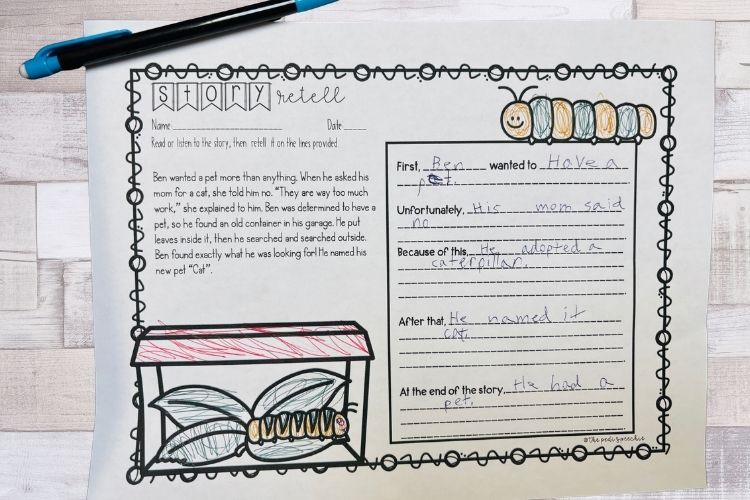
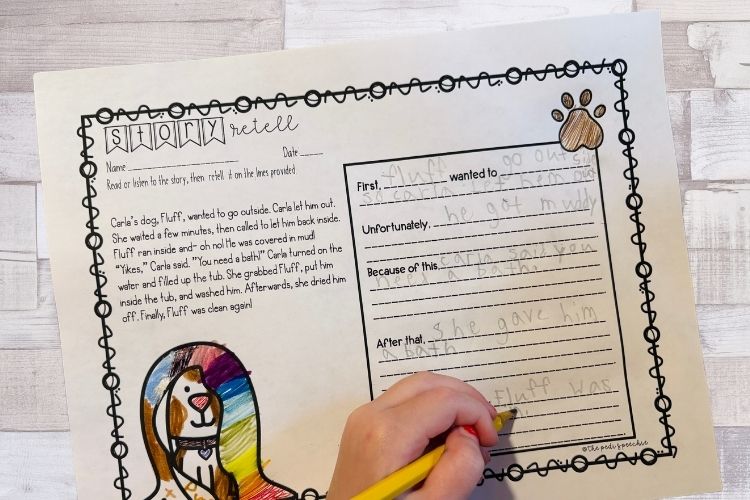
As a school SLP, I’ve always found sentence starters to be an excellent way to prompt my students during story retelling tasks. Try using sentence starters such as: “The main character was…”, “But the problem was…”, “And after that…”
Want an easy way to get started with using sentence starters? Try these retelling a story worksheets.
Story Retell Worksheets for Speech Therapy
These story retell worksheets include written sentence starters to assist your student. It’s an easy grab-n-go option to add to your story retelling materials. It includes a short story on one side of the page, and finish-the-sentence lines on the other side.
Theresa K. reviewed, “The comprehension stories with retelling prompts were an invaluable resource for my students. The structured prompts guided them to revisit the text, allowing them to locate key details and develop a deeper understanding of the story. This approach not only improved their comprehension skills but also enhanced their ability to retell stories accurately and confidently.”
Ready-to-use activity: Story Retell Worksheets
Why Is Movement So Important For Learning?
I love using movement during my speech therapy sessions- and there’s a good reason.
Research supports it for a variety of reasons.
It helps students stay more focused during speech therapy sessions and makes lessons more engaging and motivating.
It also supports executive function, reduces cognitive overload, and provides multisensory input.
Retelling a Story Worksheet with Sequenced Pictures
If you’d like sequenced pictures paired with a simple story, look no further than these story retell worksheets.
This retelling a story worksheet set is perfect for younger elementary students because they include movement activities (such as hopping, twirling, and squats) to engage students while they practice story retelling.
Lindsay L. reviewed, “This is exactly what I was looking for! A visual representation of stories with sequencing to help with re-tell.”
Ready-to-use activity: Sequencing Worksheets with Pictures for Story Retell
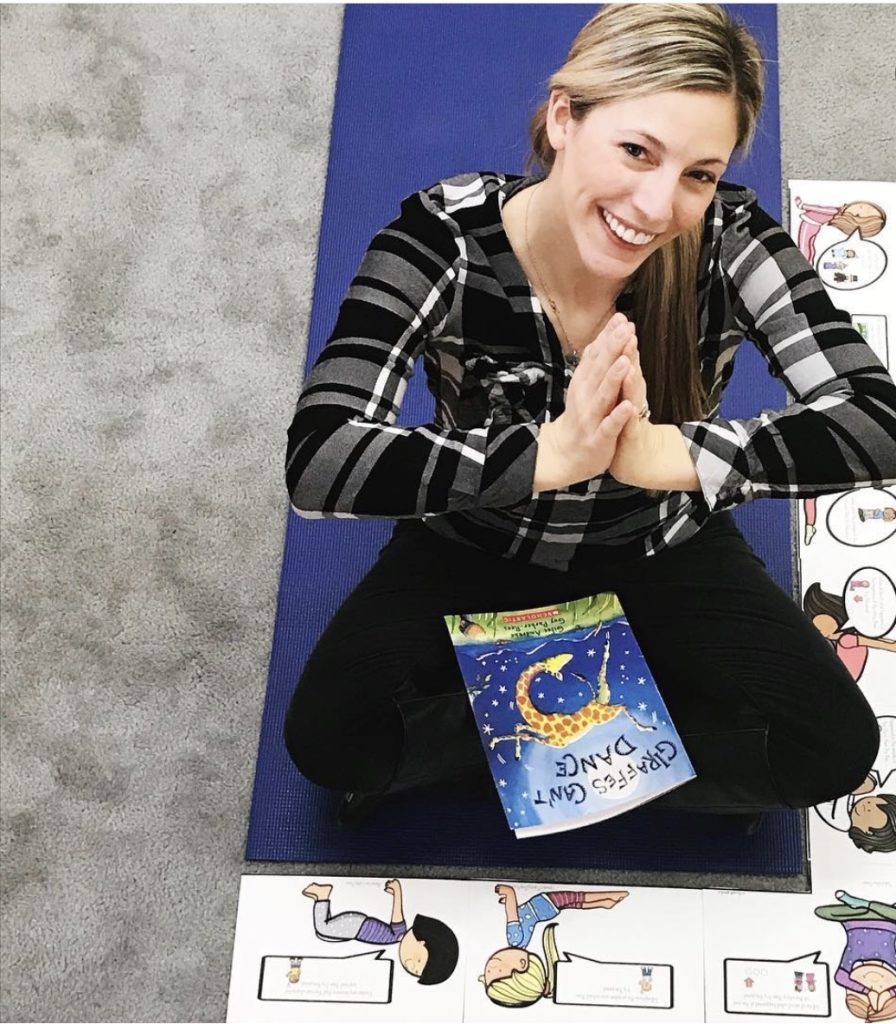
Story Retell Yoga Mat Companion
Kids need movement, and movement helps encourage learning.
This is a unique activity that will help SLPs “switch things up” during speech therapy sessions.
Your student can work on skills such as identifying the characters, setting, and other story elements. Each target is paired with a yoga pose.
Kristin N. reviewed, “Loved using this with our OT for our collaboration groups!”
Try this Yoga Mat Story Retell Activity
Books to Read In Speech Therapy
Looking for some books to pair with your story retell goals in speech therapy?
I love using books in speech, because they’re an easy way to target so many skills.
Find the perfect story on the children’s book list.
FAQs about Story Retell
Working on retelling stories is a fantastic way to strengthen narrative language skills, increase comprehension, build expressive language skills such as vocabulary and sentence structure, and support classroom and academic success.
Story elements are the core components of a story, and include characters, setting, problem, events, and resolution. More detailed elements also include the initiating event, feelings or internal response, and theme.
SLPs can try modeling, showing visuals, using simple story maps, using sentence starters, asking guided questions, and recasts and expansions.
Story retell goals might include:
1) Identify the character, setting, problem, solution, and resolution
2) Use sequence words (such as first, next, then, last) to retell a story
3) Use casual vocabulary (i.e. because, since) during story retell tasks
4) Answer WH-questions related to story elements (i.e. character, setting)
5) Given a 3-step picture sequence, arrange the pictures in the correct order
6) Orally describe what happened first, next, and last when provided with a 3-step picture sequence
Story Retell Activities Speech Therapy: Recommended Worksheets, Activities, and Tools
Here are the recommended activities and tools mentioned in this article:
- Story Retell Worksheets with written sentence starters
- Movement-Based Story Retell Worksheets with picture sequences
- Yoga Mat Story Retell– use with any book!
- Storytelling Dominoes
- Dry-Erase Literature Charts
- Story Champs Kit


Can you please offer a link or more user friendly option to download free materials? Some districts do no allow add-ons for download options due to restrictions on teacher computers. Thanks for the wonderful materials to support SLPs!
Hi Susan! I’d be happy to help. The “Book Boost” freebie associated with this article is available at this link: https://thepedispeechie.kit.com/452e594266. If you needed help with a different link, or if that still did not work, please feel free to email me! karen@thepedispeechie.com