
Lisp Speech Therapy | Articulation Therapy
Articulation Therapy for S
Your student has an interdental lisp– or maybe a lateral lisp– and you’re feeling stuck. This feeling is something I came across often in my speech therapy sessions. One day, I decided it was time to do something about it. I wanted to correct those lisps. I’m somewhat of a perfectionist when it comes to articulation therapy. I can’t help it. I get so, so excited when my students make progress!

Orofacial Myology
Alright, I took CEU courses. I was trying, y’all. I really, really wanted to help my students out. I tried these straightforward approaches- I sometimes saw results, and sometimes I didn’t.
“Hide your tongue,” I’d tell my student. Distorted /s/. So not cool.
“Okay, say the word “sun”, but say it like this: thun.” Well, that did help the airflow (no longer lateralized), so progress was being made! That was seriously helpful, but I wanted a little more structure to my approach.
Google is my friend. One day, I started searching. I don’t remember what I typed in. Probably some panicked “someone PLEASE help me correct a lisp” keyword was entered into my google search bar. It worked, because I read about this whole Orofacial Myology thing.
“Is this like a, ‘let’s blow a cotton ball through a straw with puffed cheeks for no rhyme or reason because I’m attempting oral motor stuff'”?’ I asked myself. I was a little skeptical. This is truth, you guys. I’m not trying to sound like some infomercial. I was getting desperate, but I decided to find out more. I found this website called orofacialmyology.com and I was pretty interested. Figuring I had nothing to lose, I decided to check out the 28 hour ceu course, tenderly labeled as Sandra Holtzman’s “Boot Camp”. I should probably let you know: my husband is a dentist, so maybe I was a little more open to what orofacial myology might have to offer to me as a Speech- Language Pathologist. Anyways, I signed up, and I went. It. was. awesome. (P.S. I am not receiving any sort of financial compensation from orofacialmyology.com for writing this post. All opinions expressed in this article are true, honest, and my own).
How Do I Correct a Lisp?
I learned a lot at that course. Prior to going to this course, I found out that I am a “class II”. At the course, I learned even more. I am the PROUD owner of a stressed out mentalis (thanks to my class II). In addition, my masseters… they’re like, those girls at the gym who pick up the 1 lb pink weights and still look fresh and perfectly manicured at the end of a workout. Basically, I’m not perfect, but I can still produce a pretty spot-on /s/ and /z/, despite all of this. My point, though: orofacial myology is important, and can be incredibly useful to the Speech-Language Pathologist. Also, your mentalis does not need to fit into skinny jeans. You can still be awesome and correct a lisp even with an overactive central muscle of the lower lip that is working overtime to keep your lips together even with your teeth are, apparently, not aligned perfectly. But, I digress.

Articulation Therapy: Asking the Right Questions
Prior to this course, I wouldn’t have known just how important it was to ask background questions such as, “Does your child- or has your child ever- sucked his thumb?” Prior to this course, I didn’t give all the sippy cups with hard, stiff spouts at Wal-Mart a death glare. (Please recommend to parents that an actual cup, or at the very least, a cup with a soft, flexible straw or spout is being used to encourage the correct lingual resting posture). Prior to this course… I wasn’t able to correct that lisp like a boss. Now, I do- and you can, too.
Lisp Remediation
I went home from Sandra’s course, and decided to try her methods out. You see, I have to try things out for myself. I know you do, too.
In order to correct a lisp, I’ve found that negative oral habits, such as thumb sucking, have to be eliminated prior to beginning therapy.
In order to correct a lisp, I’ve found that my students need to spend time realizing where the tongue should be at rest. If your student is sitting there, chilling with an open mouth posture and lingual forward positioning at rest, this needs to be addressed. Teeth shouldn’t be canoodling with the tongue tip all the time. I’m just saying.
In order to correct a lisp, my students need to demonstrate proficiency with coordinated lingual movements. (I can’t take credit for this, you guys! Phase one of the Myo Manual!)
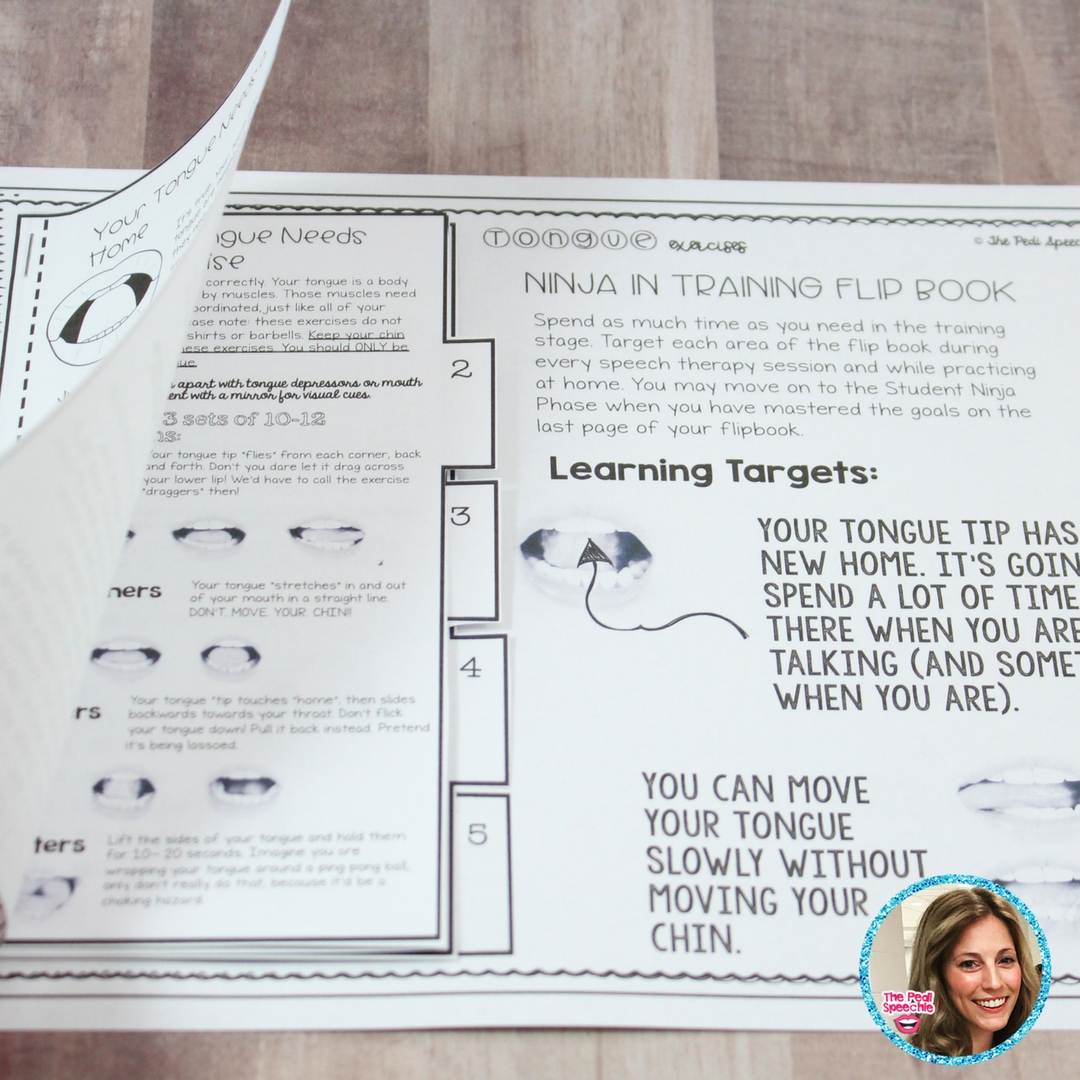
Once the foundational skills are set, my students show remarkable progress when I use techniques such as the “whispered t” and the “long t” to elicit /s/ in isolation.
When we move on to carefully selected final /ts/ words, phrases, then sentences: they are ready, because we have followed an incredibly structured hierarchy. These practice targets don’t contain any competing /s/, /z/, or /th/ targets. Finally, we use co-articulation strategies and produce /s/ in the initial position of words.
The honest, amazing truth: I’ve seen results. I’m so, so excited to share these therapy materials with you. I’m so, so grateful to Sandra Holtzman for allowing me to create materials based off of her techniques.
Please… go out there, and correct that lisp like a boss.

